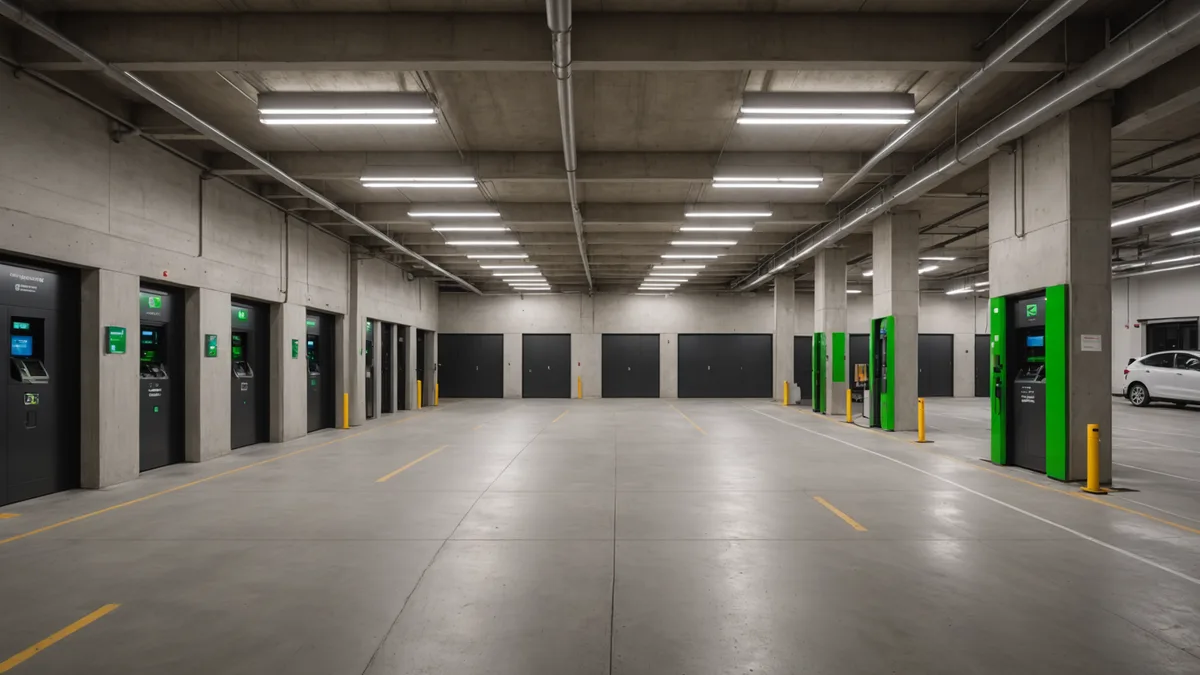
A property manager at an IT park in Bengaluru's Whitefield corridor told us that three of their top ten tenants raised EV charging during the last lease renewal discussion. None called it a dealbreaker, but all three said they would raise it again next cycle if unresolved. That captures the Grade A commercial real estate position: EV charging is not yet essential, but it is climbing the expected-amenities list faster than facility teams anticipated.
CRE charging differs from highway fast-charging and standalone public charging mainly because of dwell time. At a commercial property, drivers park for 8 to 10 hours rather than stopping for 20 minutes. That changes the infrastructure, billing model, and support requirements.
Why AC Slow Charging Fits Most Commercial Properties
A 7.4 kW Type 2 AC charger adds roughly 40 to 45 km of range per charging hour. For a driver parked from 9 AM to 6 PM, that is enough to move most EVs sold in India from empty to full. DC fast chargers deliver 30 to 180 kW for a substantial 15 to 30-minute top-up, which does not fit office parking.
DC fast chargers cost much more per unit, typically Rs 4 to 12 lakh versus Rs 50,000 to Rs 1.5 lakh for an AC wall-box. They also draw more peak power and produce more heat in enclosed basement parking. For a property beginning with 8 to 20 chargers over two or three parking levels, AC fits the deployment profile.
Mixed-use properties are the exception when office tenants share parking with retail or food-court visitors. Office users dwell for 8 hours, while visitors stay 1 to 2 hours. A surface-level DC fast charger can serve visitors as a premium option, separate from basement tenant-amenity charging.
Power Supply: The Infrastructure Questions That Matter
Facility teams most often ask whether their transformer can take more load. The answer depends on existing load, transformer rating, and the number of chargers being added.
A 200,000 sq ft office building with a 630 kVA LT transformer at 65 to 70% peak load has about 190 to 220 kVA of headroom. Twelve chargers, written as 12 x 7.4 kW AC chargers, draw 88.8 kW at full load, or roughly 100 kVA at 0.85 power factor. That fits in theory, but continuous operation at 95% peak is unwise. Load management capping simultaneous draw at 60 to 70% of charger capacity is good practice and can extend transformer life.
When transformer headroom falls short, you can file a DISCOM load augmentation application, adding months and capital cost for sanctioned load, or install a dedicated new LT connection for charging. The dedicated route is often faster near a distribution transformer with spare capacity. Your DISCOM relationship and local feeder determine what is practical.
Check the existing LT panel capacity and cable-run distances to planned charger locations. Older basement parking may have little cable tray space and long runs from the main panel, raising civil and cabling costs.
Billing: Three Approaches and Trade-offs
CRE operators are not electricity distribution companies and generally should not act like one. Your billing model sets the operational complexity you assume.
Include charging in service charges. Add estimated charger electricity costs to the annual service charge for all parking tenants or all tenants. There is no per-session billing, payment gateway, or monthly reconciliation. The drawback is cross-subsidy by tenants without EVs, which creates friction when EV adoption reaches 20 to 30% of the parking population. This works well early, while EV penetration is low, and avoids payment-capable chargers.
Direct billing per session. Use payment-capable chargers with UPI integration, letting drivers pay per session or per kWh through the charger's app. The property earns revenue, or covers electricity costs, without subsidization. This requires a billing platform subscription, payment gateway agreement, and process for billing disputes and session failures. For properties with more than 20 chargers, it is almost always the right end-state, even if service charge recovery comes first at low volumes.
Revenue share with a charging network operator. The property supplies parking space and power; the operator installs, maintains, and runs the chargers, manages billing, and pays 15 to 25% of session revenue per kWh dispensed. The property has zero operational responsibility. The trade-off is less control over pricing and driver experience, with a modest revenue share. This suits properties seeking the amenity with zero operational burden.
Regulatory Context in India
Ministry of Power guidelines on EV charging infrastructure, revised 2022, allow electricity sales for EV charging without a distribution license and place charging service providers in a distinct category. The rule covers public and semi-public charging infrastructure.
For captive premises such as a single-ownership office park, the position is generally more permissive: the owner distributes electricity on its premises to its own tenants or employees. The central compliance issue is accurate billing metering. For per-kWh billing, meters should be calibrated and accepted by the state electricity regulatory commission. With service-charge recovery and no per-kWh billing, metering standards matter less.
Verify current state-level guidance with your facility's electricity consultant. DISCOM interpretations vary and have changed multiple times as the EV charging framework has developed.
First Six Months: What We See
This is not about running charging as a standalone revenue center in year one. It is about choosing cost recovery plus tenant satisfaction given low session volumes, rather than expecting monthly revenue to meet targets. That framing avoids undersized installations and disappointment.
Early utilization at new CRE charging sites is typically 15 to 30% across the fleet and rises as more employees acquire EVs. Sites that begin with 8 chargers and plan modular expansion to 20 or 30 perform better than those installing 20 on day one, leaving 15 idle for the first year. Lay expanded civil and electrical capacity on day one, including cable conduits and panel breaker positions, then phase in charger hardware.
Charger support demand at a commercial property is real and often underestimated. Drivers call building reception when a session fails. Building management needs a clear escalation path to a platform operations center or field maintenance team. Set it before go-live to avoid common early frustration for tenants and facility staff.