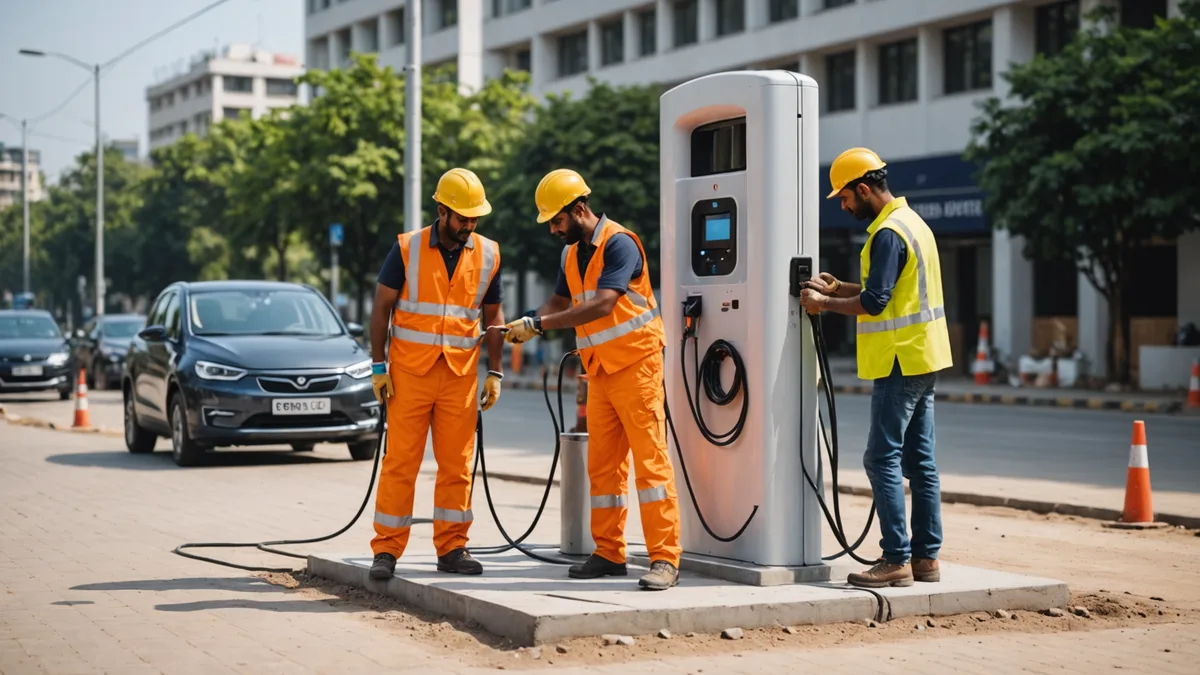
In the first 90 days, can the transformer support your planned load, will DISCOM approve the connection, and which hardware should you buy? Hardware is often the fourth or fifth concern. Confirm grid capacity first.
This article addresses the questions that repeatedly arise during a new charging operation's first 90 days in India, ordered approximately by their effect on your timeline.
Site Selection: Dwelling Time Comes First
A charging site's commercial viability depends more on parking duration than passing traffic. A site with 400 vehicles per day but 15 minutes of parking, like a petrol station forecourt, suits AC slow charging poorly. A site with 80 vehicles per day and 6 to 8 hours of parking, such as a corporate basement or residential apartment parking area, can work very well with AC chargers.
Once dwelling time is established, grid connection availability becomes the gating constraint. Existing commercial or industrial LT service, transformer headroom, and spare breaker positions in the main LT panel make a site straightforward. A new LT service from the street, or a fully loaded area transformer, adds months and capital cost regardless of other advantages.
Assess both factors before signing the site agreement. An enthusiastic landlord may not realize the transformer is already at 95% load and the DISCOM has a 6-month augmentation queue.
DISCOM Approval: The Actual Process
Adding chargers beyond current sanctioned capacity requires a load augmentation application to your DISCOM. In Karnataka under BESCOM, existing consumers adding load typically use Form LP-B. Submit current sanctioned load, requested additional load, and documents including a site layout.
LT commercial augmentation timing varies widely. Within Bengaluru limits, a straightforward application on a healthy feeder may move in 3 to 6 weeks. If the local distribution transformer is loaded, BESCOM may plan an upgrade or new DT installation, extending the timeline to 4 to 8 months. The answer comes only after filing and a DISCOM engineer's site survey.
Operators in Maharashtra under MSEDCL or Delhi under BSES/TPDDL face a similar structure, but forms, timelines, and tariff categories vary. Engage a licensed electrical contractor familiar with your DISCOM at project start, before setting a hardware procurement timeline.
To avoid DISCOM augmentation delays, use an existing connection with unused sanctioned load for a smaller initial deployment, if capacity permits. Expand after approval. This phased route can start site revenue while the grid upgrade moves through its queue.
Transformer Sizing for a New Charging Site
For a new dedicated transformer, sizing follows your planned charger count and intended load management method.
For AC 7.4 kW chargers with active load management, a conservative rule is 70% of peak theoretical draw. For 6 x 7.4 kW chargers, that draw is 44.4 kW. At 70%, it is 31 kW, within a 63 kVA transformer at 0.85 power factor. For later additions, choose a 100 kVA transformer for a 10 to 12 charger deployment, avoiding a second capital event.
For sites with DC fast chargers of 30 kW and above, account for each charger's much higher draw and their limited ability to throttle smoothly like AC chargers. Have a licensed electrical engineer complete a load flow analysis before specifying the transformer.
New transformer civil work, including the transformer bay, cable trench to the LT panel, and conduits to charger locations, is typically the second-largest cost after hardware. Budget Rs 3 to 8 lakh for a small commercial site, depending on distances, floor type, and whether construction is existing or new.
Hardware Vendor Selection: Three Checks
Before choosing a hardware vendor, check three points: OCPP 1.6J conformance, IP rating, and local service availability.
OCPP 1.6J conformance, preferably supported by an Open Charge Alliance conformance certificate, means the charger uses the industry-standard protocol and can connect to your management software. Proprietary protocols create software lock-in. Confirm your CSMS has been integration-tested with the exact charger model, not merely the vendor's other models.
For Indian outdoor conditions, chargers face monsoon rain, high ambient temperatures, and dust. IP54 is the minimum for covered parking; IP65 is recommended for outdoor surface sites exposed directly to rain. Several manufacturers offer Type 2 AC chargers for outdoor use with IP55 as standard.
Local service matters because charger failures cost revenue for every day they remain unresolved. A vendor without an authorized service partner in your city means a 5 to 10 day repair window at minimum. Confirm city-level coverage before purchase and obtain the response-time commitment in writing.
Payment Rails: UPI Is Standard, Details Matter
UPI is India's dominant payment method for EV charging drivers, and most sessions on our pilot network begin and end with UPI. New operators need a payment gateway agreement with a UPI-capable PG, such as Razorpay, Cashfree, PayU, or Paytm Payment Gateway, plus PG integration with charging management software.
Before launch, confirm settlement timing, T+1 or T+2 after session completion, failed-session refunds, and the per-session transaction fee. A session that starts without delivering energy should refund automatically. UPI fees are capped at zero for peer-to-peer payments, but merchant transactions via a payment gateway typically cost 0.5 to 1.8% plus applicable taxes. Include this in pricing.
We are not dismissing pre-authorization holds. They serve a different operator profile. This article is about the operator profile where simpler payment flows apply. Holds need PG support and add complexity. For most early-stage deployments, a session initiation fee or minimum charge is simpler and reduces failed payments.
A Realistic 90-Day Launch Timeline
A 5-charger commercial site can go live in 60 to 90 days when DISCOM approvals do not block progress. DISCOM timing creates the largest variance. After power supply is confirmed, hardware procurement, civil work, software setup, and payment integration usually fit within 4 to 6 weeks.
Rough sequence: weeks 1 to 3, finalize the site agreement, file the DISCOM load application, and engage the electrical contractor for civil scope and transformer sizing. Weeks 4 to 8, order hardware, most AC chargers ship from Indian distributors in 2 to 4 weeks, and start civil work. Weeks 6 to 10, configure software, set up payment gateway, and train staff on the operations dashboard. Week 10 to 12, install and commission electrical systems. Week 12 to 14, soft-launch with a limited driver group before public opening.
Delays usually follow an underestimated DISCOM timeline or civil work and hardware commissioning started before power supply was confirmed. Sequence the work carefully. Power-supply readiness is the variable that most determines the outcome, and charger hardware goes in last.